First published in the Central Asian Journal of Management, Economics and Social Research, Issue 2, June 2001, by the KIMEP Center for Research and Development, Almaty.
III. World Economic System and its main characteristics
Numerous western analysts have noted that the world economy functions as ‘One Unique System’. The origin of this idea comes from the great French historian and economist Fernand Braudel (1985). He launched his theory in the 1970’s, which seems to be mostly related to the so-called period of “Internationalization” in the world economic evolution (Schwald, 1995, p. 42). Immanuel Wallersteinv in the United States has been working on this theory which is based on the idea of Capitalism functioning as one whole system with one World Center.
Following Braudel’s theory, at least in 1970’s, one can say that the World Economic Center is the United States, particularly with the city of New York considered to be the heart of all major economic activities in the world. Consequently, we understand that the World System is highly hierarchical. Today, many things have been changed. A new theory of world economy is needed to be established, capable to explain the characteristics of the current world system. In the phase of Globalization, the World Economic System has a new formation. Some of its suggested characteristics are elucidated below.
Three economic blocks
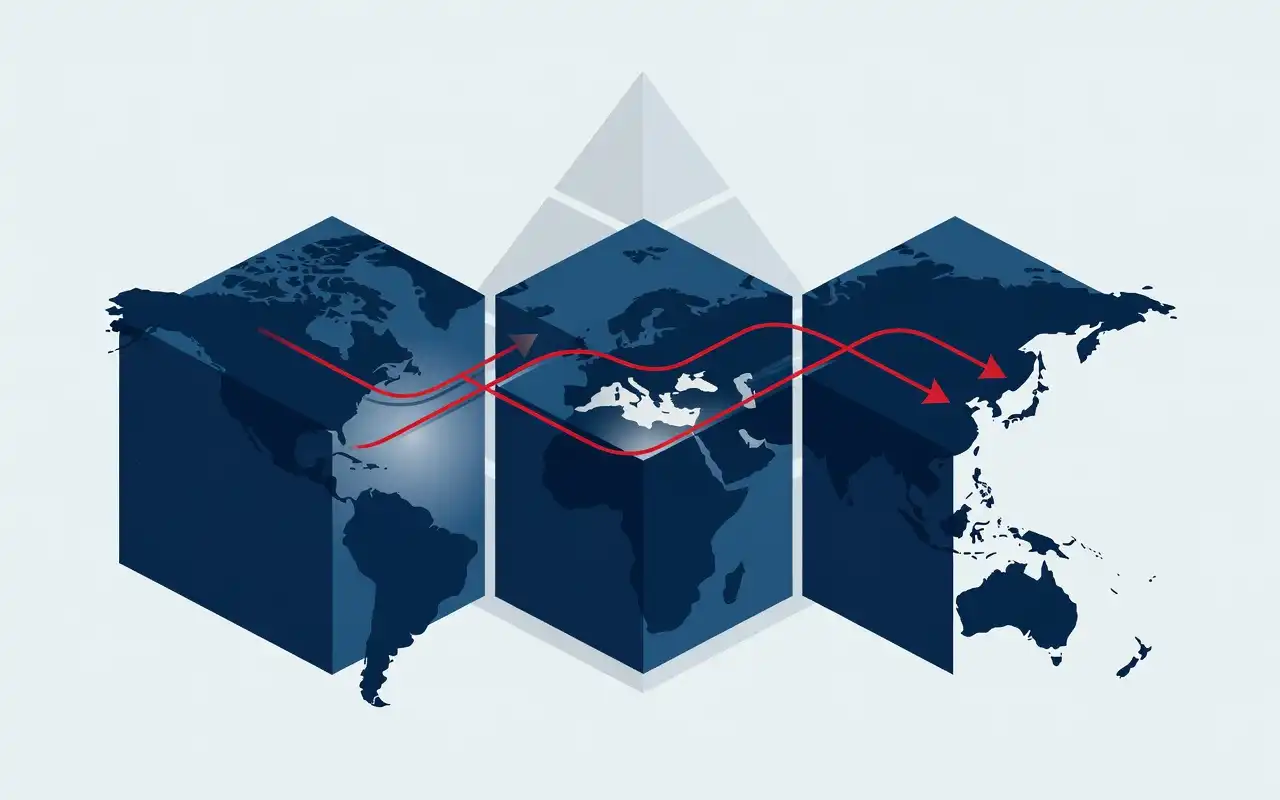
Observers have noticed that in the phase of Globalization, the World Economic System is based on the emergence of three different economic blocks in three regions of the planet: Europe, America and South-East Asia. That is called the ‘three-polar core’ or the ‘Tripolarity’ (Cordellier, 1997; Lafay, 1996; Defardges, 1993). In each of these regions, many economic Associations are active, but only one between them coordinates or dominate the activities of the whole block. These regional/continental associations, in competition with each other, are the European Union, NAFTA in America and ASEAN in the South-East Asia. Each of these regions is organized based on geographical proximity with some inherent cultural affinity on a closer observation (Hoodashtian, 2001a).
Following the emergence of the Tripolarity and the formation of the world major economic groups, the fate of the so called world economic Center is now uncertain. Two hypotheses have been launched at this stage:
a- The first one underlines the idea that the USA continues to remain the world central economic power, because all other structures are following more or less an American model; and also because of its internal econnomic health and also because American companies are actively involved in the global economy, controlling a big part of the world economic outputs. (Laïdi, 1994). But, in recent times however, there are many new theories from the American scholars envisaging the ‘Decline of the USA’ dominance (Kennedy, 1989, pp. 570-587).
b- The second hypothesis stresses the idea that, because of the emergemce of the Tripolarity, we do not have a specific World Center with the characteristics prescribed by Braudel. According to this hypothesis, the world in the time of Globalization is in a transitional period. The present Center seems to be vulnerable to transition to a yet unknown geographic new destination. This could be eventually the East or the South East of Asia, which is currently in strict competition with the United States (Hoodashtian, 2001b).
Difficulties for the World Economic System
In the time of Globalization, there are no more essential ideological or political conflicts between the most active western and eastern countries and the Tripolarity does not create any political oppositions between the blocks. In fact, even the concepts of the West and the East do not have that geopolitical identification implemented in the period of the Cold War. However, there are still some inherent problems here.
Three difficulties have appeared since the end of the Cold War:
1) The geopolitical fragmentation which besieged some ‘marginal’ countries like Yugoslavia. However, nationalism, the origin of such fragmentation, does not pose any real and fundamental ideological opposition to liberalism and/or the general politics of the West. Almost all of these new independent countries are applying the free market economy.
2) The emergence of some political dictators as in Iraq, coming up in direct confrontation with the West. Yet this isolated country, in War against the majority of the western powers, has not been able to organize any real mobilization in the non-western countries. Moreover, Iraq has been unable to establish an anti- Occidental political block, because there is lack of any specific political program or substantial economic capacity, capable to challenge the West and to create a real anti-western block.
3) But the most important political and ideological antagonist to be noticed since the end of the Cold War was the emergence of Islamic fundamentalism, starting with the Iranian revolution in 1979. The focal point and ideology of this revolution was to set and mobilize any countries against the West, capitalism and its universal development. In fact, the Easter Block did not support this revolution, which was realized in the period of the Cold War, wholly. We noticed the first stages of an event that nearly took shape beyond the two blocks before the end of the Cold War. Fundamentalism, does represent a minor problem in the world economical and political arena, in comparison with the whole problems of the World System enhanced by Globalization movement. Why? Because, Fundamentalism in over 20 years of its existence, could not influence or disturb the main objectives of the Global movement of capitalism and its rush from the West to the East. Basically fundamentalism cannot effectively impede the movement of Globalization, for the simple fact that Islam, from the beginning, did not have (and basically does not have) any real economic program which could be presented as an alternative to capitalism. And the so-called “Islamic Economy” (Banisadrvi, 1982), launched by some Iranian activists and theoreticians, seemed not to be viable practically even in Iran during the height of Islamic State.
As mentioned, none of these three fronts against the West was able to create a real ‘block conflict’ and divide the world into two parts, as we noticed during the Cold War.
4) There exist certain political confrontations between ex-soviet countries, China and the West. But apart from some exceptions, again, such confrontations are insignificant enough to create any ‘block conflict’. In fact, almost all countries in the world (except Cuba, North Korea and Afghanistanvii), implicitly and/or explicitly now agree with the necessity of converting to the Free Market Economyviii. Today, it is well known that even China, Cuba and North Korea do not represent any more the real communism States.
The main confrontations between countries applying this free market economy would originate from the rules of the game and possibly the issue of State provision of Social welfare scheme. Some socialist movements in France and other western countries continue to criticize what is called the “excess of Globalization”. They propose that State should continue to support the poor masses and provide Social Security system for society. The “Anti-Globalization” pressure group has developed stronger in the last ten years in Europeix.
The three European socialits leaders in the UK, Germany and France are not always following the United States plans. We know that the UK is an exeption, representing a very pro-Amarican power in Europe, but the main opposition comes from the last two countries, and especially from France. The head of the French socialist Government, Leonel Jospin, who some time acts independally from the President of the Republic, the Centrist Jacques Chirac, representing, in fact, the largest party in France, launched his last political program related to Europe and Globalization against the American line and the one which has been prononced by the head of the German Government. He supports more social security, the establishment of certain rules in the market competition, and certain level of the State intervention in the society (Le Monde, 2001, 30 and 31 May; Financial Times, 2001, May 29).
5) The diverse zones of the free market economy, serve as the main force of today’s process of Globalization, have been progressively creating other zones including countries that are located in the periphery of the main three blocks. But “periphery” is not a new phenomenon of capitalism. We have always observed, in modern times, the movements towards ‘Centralization’ and ‘Marginalisation’ in the capitalist system. Some theoreticians tend to ignore these movements when they analyze Globalization, considering them a classical approach for describing international capitalism. However, within this periphery, some countries like Afghanistan, Tajikistan and others in the south and central Africa are still too poor to be integrated into the whole World Economic System as yet.
Consequently, we are far from the “Third World” theory of Alfred Sauvy (1989), the French inventor of the terminology and far from that geopolitical conception. But, we need to understand that today’s World Economic System still has the form of a pyramid based on three hierarchical levels. First level: the countries located in the three regional blocks; Second level: those that are situated on the ‘periphery’; Third level: the poorest countries.
Westernization
The international economic movement, which follows Globalization, is Westernization. It does not imply that all countries that embrace a free market economy have become a part of the West. The whole world is not becoming a part of the West, but westernized! This means that countries are becoming directly influenced by the process of modernity. Modernity is the basis of the western model of culture and civilization. As we noticed, Globalization is a world movement with a specific direction: from the West to the East, but this movement is never limited to only an economic sphere. Modernity is the foundation for western culture and achievements in economical and technological advancements. Therefore, Modernity is not Modernization. It is more than that. Modernity is present everywhere we see western technology, western education, political thoughts, and concept of Civil Society etc (Hoodashtian, 1997; Nze-Nguema, 1989; Habermas, 1989, 1980; Lefevre, 1962).
To take some very practical examples: Westernization is responsible for the domination of English language in the world. This movement has been highly developed since the 1980s, the starting period of Globalization. Today English language has become the major language of business and international communication. About 85% of the web-sites on the Internet are in English. English language is taught as a second language in many schools all over the world. The same goes for the Anglo-Saxon culture, the younger generations in developing and even in poor countries prefer English/American music and films. American film industry, during the last two decades has achieved a total domination of the world movie industries. From a political point of view, we can assert that nowadays almost all countries even the Islamic Republic of Iran, but with the exception of Cuba and North Korea, are talking about democracy. A kind of international competitions between non-western countries have established to prove which country is more democratic than the other!
In short, today’s most evident geopolitical realities is that non-western countries following Globalization are in the process of becoming westernized. The westernized countries are the non-western countries that use technologies based on the western conception, thus gradually becoming more westernized, but yet not giving up their own traditions. Certainly, one can observe a moderate conflict between modern/western values, on one part, and local/traditional values, on the other. This confrontation will never cease to be, as none of the two actors will be eliminated. To clarify this problem, some points need to be stressed:
IV. From Confrontation of values to Métissage of values — The Rise of Asia
Globalization is also the rise of Asia, the acceleration of contacts between East and West, and the confrontation between the modern and the traditional values in the non-western countries. Such international interactivity has its positive sides, one of which is that it allows the eastern countries to use the western technology for developing a domestic economy. The non-western countries, in Asia, Middle East and North African, are the best examples of such development process. In fact, the utilization of western technology has been among the advantages enjoyed by the non-western economies for the whole period of colonization and the neo-colonization. From 1960s-1970s, some of these non-western countries became progressively more familiar not only with utilization of the technology, but also with its main structures, functions, and more importantly, its conceptions. The concept of technology is the philosophy based on which the whole modern technology is constitutedx. This process of becoming familiar with the structure and conception of modern technology helped the most active non-western countries to produce progressively the western model of technology!
From ‘utilization to production’, an important historical transition in the structure of the World Economic System was born, in which the ex-colonies are becoming the new industrialized countries and actively competing with the West. This is the significance of the rise of Asia. South Korea, the countries of the South East Asia are among the fastest. In 1970s-1980s, they have been called the ‘NICs’ (newly Industrializing Countries). Today, all the country members of ASEAN are in this exceptional processxi. It is impossible to conceive of the economic performance of these non-western countries without the process of Globalization.
Métissage of values
As different regions of the world apply more and more western technology, embrace market economy, western democracy, and western model of education, they however do not become a part of the West but westernized. One very important fact is that: Westernization seems to stimulate local values, as newly industrialized countries retain their national, ethnic and cultural identities (Hoodashtian, 1997). This stimulation appears as an ‘Identity Resistance’ manifested by each country as they join the world movement and Globalization, which tends, by nature, to eliminate all differentiations. Globalization tends to homogenize the world. So, the more it is developing, the more Identity Resistance seems to attract people in some non-western countries.
Here, I am going to look into this from the point of view of political and cultural values prevalent in the regions in question.
1) At the beginning of the movement of Globalization, around 1990-1997, the major debate among the western scholars was based on the vital question of whether Globalization, which is imposing to different domestic economic structure one and the same type of technology and model of production, could promote a certain political and cultural homogenization among different countries (Fukuyama, 1993). In other words: It is right to say that technology, rational by concept and construction, has the same nature and function all over the world. There is no ‘geographical’, ‘racial’ or ‘cultural’ priority for technology to be used (Ellul, 1977). Technology is not a racist! Once it is understood as a need, in India, in Africa, in America, all people are capable to use the same technology in the same way. The utilization of computer technology is the best example. Who could imagine, in the 1950s or even in 1970s, that the computer which possesses one of the most complex structures, could be used by all nations of the world in such an easy way? Who would believe that this technology was soon to be used one day in all areas of the society like: hotels, restaurants, universities, companies, ministries, creating a real world network as e-book, e-shopping, e-commerce, e-development, e-government, e-democracy, e-group, even e-diets and so many other e-s ? (The Economist, 2000).
The main question is in spite of such a common and general utilization of the same technology, we do not notice countries becoming closer to each other. Contrary to what Francis Fukuyama, in his famous «The End of the History», had expected to see, we did not notice the same understanding of the need for world peace, the same conception of democracy and Human Corporation among nations. Despite Globalization and penetration of the western technology in all countries, we did not see fewer wars around the world; we did not see peace dominating everywhere. This means that utilization of the same technology does not produce, mandatory and all round the same culture. According to some other authors, Globalization has prepared a better ground for new political conflicts between international powers through nationalism and the emergence of religion. According to Sammuel Hungtinton, Globalization is creating a heterogeneous situation which stimulates confrontations between countries. From the beginning of the 1990’s, we could notice in many developing countries, in Eastern Europe, Middle East, etc., the movement towards regional independence. Some countries become smaller due to internal divisions, such as in the ex-Yugoslavia. Along with the emergence of nationalism, we notice that emergence of regional conflicts, particularly Islamic, in Middle East, North Africa and in some Asian countries, has created another source of confrontation between the West and the East (Huntington, 1996).
2) In short, the international economic movement of Globalization, or the process of Westernization, seems to stimulate local values and universal utilization of technology, though does not influence this reality very seriously.
For example, the Central Asian countries and specially Kazakhstan after the end of the Cold War established very advanced relations with the West and attracted numerous American and European companies to its territory. Westernization in Kazakhstan seems to have taken a fairly rapid pace in application of technology, business methods, and structure of education. At the same time, one of the first actions of the President of the country was to reinforce and support preservation of Kazakh language along with the Russian language, which was formerly dominating in the Republic, and to promote Kazakh national traditions. Another example is Japan, which was highly dominated by the United States both economically and culturally after the World War II. After 1950’s Japan took a very serious movement towards Westernization in economy, industry, and education, while simultaneously strongly preserving some aspects of national culture (Demorgon, 1996). One can observe a moderately similar situation in South Korea.
This conflict of cultures creates a real confrontation between Western/modern and Eastern/traditional values in the non-westren countries. Nowadays, the question, and the issues of such value confrontation are possing big challenges. Scholars in Europe are focusing on this very important question, and some of them have come with ideas that the real issue of confrontation of modern and traditional values would be the creation of new context which could be called “Métissage of Values” (Barbier, 1996). This is a Métissage of Western and Asian values, in which non-of the values will be eliminated, but combined in a new framework. The Métissage is a framework which will not be anti-modern or anti-traditional, but will carry both of them. It will neither be modern, nor traditional. If this Métissage concerns specific kind of values related to the cultural and spritual life, “Structural Métissage” is a combination of values at all levels of life, in culture, social, politics and other levels, in the non-western countries. (Hoodashtian, 2001, September).
Following the theory of Métissage, we understand how original would the situation be in each non-western country. Each Structural Métissage is different from another, because each Structure is realized in relation with the specific historical/political and cultural situations of that specific country. There is no universal model of Métissage. Each combination of values is unique in this senes that it has been created in a specific time, and under a specific condition and in a paricular historical context. Consequently, the theory of Métissage underlines that there is no more “real traditional society” in the world. The modernity and its values affect all countries, which are in relation with the West. In fact, Westernization of the world creates a framework of Structural Métissage in the non-western countries and pushes them automatically to emerge for facing the new problems created by this new situation. This is the same process, which motivates them to compete with the West.
In the West, the study of Métissage of values as a new Anthropological approach to the question of cultural interactions between countries is yet to be fully researched. However, the interest of scholars in this matter has increased since the beginning of the period of Globalization. At the University of Paris (St.-Denis), the Research Group CRISExii and its supgroup GREMA are focusing on the last issues of the cultural contacts between the Asia and the West.
Conclusion
Globalization is a world movement with a specific sense : from the West to the East. It should not be simply considered as an economic movement. Following the internationalization of the modern technology and the free market economy, cultural and political aspects should be taken into consideration as well. Globalization started with ‘Deregulation’ and the penetration of the capitalist model of economy based on the free market in the most parts of the world. Some scholars consider this as the best oppurtunity for the establishment of a future homogenous world. Others believe that Globalization accelrates a political antagonism between countries.
In any cases, Globalization is a global progress, highly motivating the interactivity of cultures, expression of some confrontations between Western/modern and Eastern/traditional values. For the non-western counties, this confrontation could create a kind of combination of values at all levels of the society, what we could call, in this study, ‘A Structural Métissage’.
Endnotes
- i This article has been published for the first time in the Central Asian Journal of Management, Economics and Social Research, Issue 2, June 2001, by the KIMEP Center for Research and Development, in Almaty.
- ii This Conference was given to the second and third year students at ‘Eurasian Market Institute’ in Almaty in January 2001. I would like to express my gratitude to Dr. A. Nurseit, President of the ‘Eurasian Market Institute’ and Ms. F. Seitova in inviting me to share some thoughts with students. I also would like to express my thanks to Aset Kopbaev, MPA, Research Assistant at KIMEP Research Center who took notes and helped me to prepare the first draft of this paper. The author has completely reviewed the last part of this paper.
- iii We can notice how the history of Russia is related to the history of the world in the twentieth century and some how, conditions it, and how the internal movements of this country could up to now modify the map of the planet.
- iv One of the specific results of the movement of Globalization was the development of Global Companies. One main difference between Global companies and a Multinational companies is in the degree of Centralization of power and, consequently, in the style of management. The first model builds its headquarter wherever there would be the possibility of a new innovation related to the profitability and the development of the company. The second model is mostly based on one headquarter which is the source of diffusion of the main decisions and orientations of the company.
- v Immanuel Wallerstein is the Director of the “FERNAND BRAUDEL CENTER for the Study of Economies Historical Systems, and Civilizations” at Binghamton University, State University of New York, which has been founded in September 1976 to engage in the analysis of large-scale social change over long periods of historical time (http://fbc.binghamton.edu/).
- vi Abolhassan Banisadr is an ex-President of The Islamic Republic of Iran for the period of 1980-1981.
- vii Certain other countries, like China and Iran, have still some ideological confrontations with the West, but practically, they are almost applying the main lines of capitalism with the State intervention. Both of them are highly, at least in theory, encouraging the private investments.
- viii Even Islamic Iran, under the reformist President Rafsanjani, and specially President M. Khatamy, does not wish any more to preserve the whole practice of the State Economy and the Government keeps inviting the capitalist Iranian living since the revolution in the United States and Europe, and encourage the western companies to invest in Iran.
- ix For the movement of ‘Anti Globalization’, see: http://www.unc.edu/depts/anthro/escobarpaper.html, and http://www.corpwatch.org/news/2001/0038.html
- x What are the modern technology and its difference from the traditional technology? See: Goffi (1988). For more information, see Heidegger (1958), (1962), Habermas (1973).
- xi ASEAN is ‘Association of Southeast Asian Nations’. Created in 1967 for promoting regional economic and political stabilities, it includes Thailand, Malaysia, Singapore, Indonesia, and Philippines. Brunei and Vietnam joined ASEAN in 1984 and 1995 respectively.
- xi The idea of Métissage is coming from my Professor René Barbier, the head of the Research Group CRISE (http://www.fp.univ-paris8.fr/recherches/accueilCRISE2.html) at the University of Paris 8. His main theory is the ‘Métissage Axiologique’, which means a combination of cultural values. But the idea of ‘Structural Métissage’ comes from this author. Described in his doctoral dissertation, and then in a book, “Une Modernité sans Occident” and in an article, “Eight models of the Structural Métissage”, this last idea refers to the point that Métissage is not only a reality of the combination of cultural and spritual values but it concerns all values, in social, politics, education etc, and would cover all aspects and the whole structure of the life of the non-western countries.
References
- Barbier, R. (1996, Août). Valeurs et sens du métissage culturel. Espace Social, Cultures et Travail Social, No. 5.
- Baudrillard, J. (1986). La société de consommation. Paris : Poche.
- Banisadr, A. (1980). Egtesad eslami (Islamic Economy). Tehran: Chapakhsh.
- Braudel F. (1985). La dynamique du capitalisme. Paris: Arthaud.
- Clark, I. (1997). Globalization and Differentiation, New York: Oxford University Press.
- Cooper, B., Kornberg, A., & Mishler, W. (Eds.). (1988). The resurgence of conservatism in Anglo-American democracies. N.C.: Duke University Press.
- Cordellier, S. (sous la direction). (1997). La mondialisation au-delà des mythes. Paris: La Découverte.
- Crise asiatique (La) (1998, Juillet). Géopolitique, No 62. Paris: Presse Universitaire de France.
- Defarges, P. M. (1993). Relations Internationales, 2 Vol. Paris: Edition du Seuil.
- Demorgon, J. (1996). Complexité des cultures et de l’interculturelle. Paris: Anthropos.
- The Economist. (1999). The World in 1999. London.
- The Economist. (2000). The World in 2000. London.
- Ellul, J. (1977). Le système technicien. Paris: Calmann-Lévy.
- Ellul, J. (1991). La technique ou l’enjeu du siècle. Paris: Economica.
- Enoch, S. S. (1993). Socrates to Sartre: A history of Philosophy. New York: McGraw-Hill, Inc.
- Financial Times, May 29, 2001
- Forsyth, M., & Keen-Soper, M. (1996). The political classics: Green to Dworkin. New York: Oxford University Press.
- Fukyama, F. (1993). The End of History and the Last Man. Avon Books.
- Gabriel, W. (1995). De l’espace national à la mondialisation. Paris: Ellipses.
- Goffi, J. Y. (1988). La philosophie de la technique. Paris: Press Universitaire de France (Que sais-je?).
- Habermas, J. (1973). La technique et la science comme idéologie. Paris: Gallimard.
- Habermas, J. (1980, Octobre). La modernité, un projet inachevé. Critique, No. 413, Paris.
- Habermas, J. (1989). Discours philosophique de la modernité. Paris: Gallimard.
- Heidegger M. (1958). Essais et conférences. Paris: Gallimard (Tel).
- Heidegger M.(1962). Chemins qui ne mènent nulle part. Paris; Gallimard (Tel).
- Hoodashtian, A. (1997). La mondialisation et la Confrontation des valeurs. Tempéte de Plume, No 10-11. Paris.
- Hoodashtian, A. (2001a). La triade: La nouvelle formation du monde. Une modernité sans Occident. Paris: Harmattan.
- Hoodashtian, A.(2001b). La question du centre du monde. Une modernité sans Occident. Paris: Harmattan.
- Hoodashtian, A. (2001, September). Eight models of the ‘Structural Métissage’ of traditional and modern values in the Eastern and Western societies. Pratique de Formation/Analyses. Paris: Department of Education, the University of Paris 8.
- Huntington, S. (1996). The Clash of Civilizations and the remaking of World Order. New York: Simon and Schuster.
- Inglehart, R. (1995, September). Modification des valeurs, développement économiques et évolution politique. Revue Internationale des Sciences Sociales, No. 145, Paris.
- Jürgen, H. (1973). La technique et la science comme idéologie. Paris: Gallimard.
- Kant, E. (1956). Critique of Practical Reason. New York; The Liberal Arts Press, Inc.
- Kennedy, P. (1989). Naissance et déclin des grandes puissances, Paris: Payot.
- Lafay, G.(1996). Comprendre la mondialisation. Paris: Economica.
- Laïdi, Z. (1994). Un monde privé de sens. Paris: Fayard.
- Lefevre, L. (1962). L’introduction à la modernité. Paris: Minuit.
- Monde (Le). (2001, May 30). ‘Linel Jospin rejette la vision européenne de Gerhard Schröder’. ‘Un Etat pour la nation européenne’.
- Mondialisation et Gouvernance mondiale (1999, Avril, 7-14), Problème Economiques, No. 2.611-2.612. Paris: La documentation Française.
- Nze-Nguema, F. D. (1989). Modernité, tiers-mythe et bouc-hémisphère. Paris: Publisud.
- Sauvy, A. (1989, Août 14). Trois mondes, une planète. Observateur, p. 62. in: Etat du Tiers Monde. Paris: La Découvert.
- Schwald, S : De l’Internationalisation à la mondialisation (1995, Jan.-Fév.). L’économie mondiale, No. 269. Paris: Cahier Français, La Documentation Française.
- Wackerman, G. (1995). De l’espace national à la mondialisation. Paris: Ellipses.
- Zaki, L. (1994). Un monde privé de sens, Paris: Fayard.